
A small blue or purple spot on the lip, ear, or face can be surprising, especially when it seems to appear without warning. At first glance, it may look like a bruise, a blood blister, or even something more serious. In many cases, however, the spot is a venous lake—a harmless blood vessel condition that becomes more common with age and sun exposure.
Understanding what a venous lake is can help remove unnecessary worry and make it easier to recognize when medical advice is worth considering. This guide explains what venous lakes look like, what causes them, how they differ from other skin conditions, available treatment options, and simple steps that may help protect the skin in the future. By the end, readers will have the knowledge needed to identify this common condition and make informed decisions about their skin health.
Venous Lakes at a Glance
| Question | Quick answer |
| What is a venous lake? | A benign dilation of a superficial venule |
| What color is it? | Usually blue, purple, or bluish-dark |
| Where is it most common? | The lower lip |
| Who commonly develops one? | Middle-aged and older adults |
| Is it usually dangerous? | No, typical venous lakes are benign |
| Does it usually hurt? | No |
| Can it bleed? | It can bleed if traumatized |
| Does it require treatment? | Usually not |
| Can it be removed? | Yes, when treatment is appropriate |
| Common treatments | Laser, cryotherapy, electrocautery, sclerotherapy, and selected other procedures |
| Is biopsy always needed? | No; it is rarely necessary for a typical lesion |
What Is a Venous Lake?
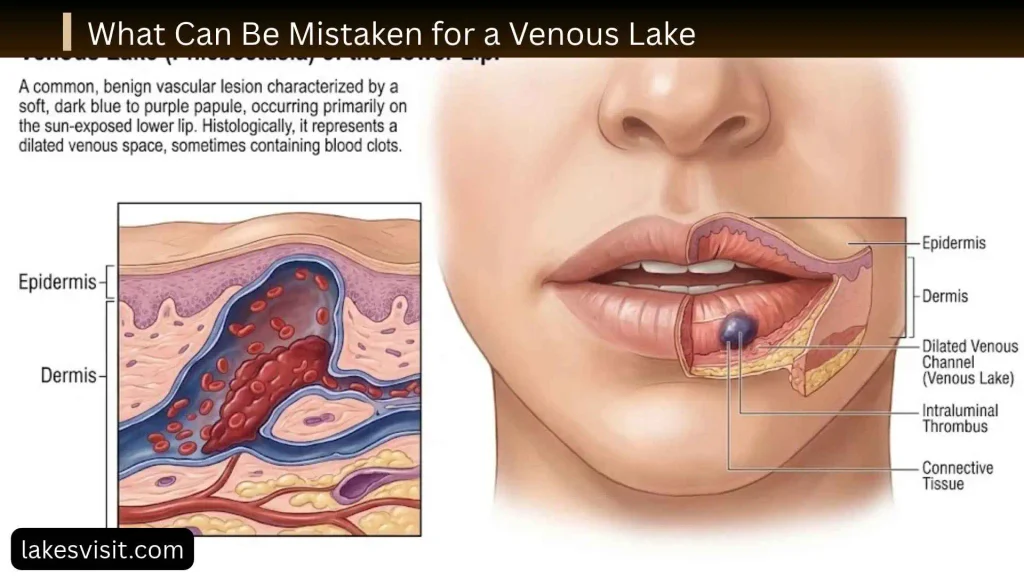
A venous lake is a localized dilation of a small superficial vein. It is considered a benign vascular lesion and most commonly appears as a soft, compressible blue or purple macule or papule. The lower lip is the most characteristic location, although venous lakes can also occur on the earlobe, face, neck, and upper trunk.
The word “venous” refers to the lesion’s connection with a vein. The word “lake” is simply descriptive; it does not mean that there is a literal pool of blood outside the blood vessels.
Venous lakes are sometimes referred to by older terminology such as acquired venous hemangioma or senile hemangioma of the lip.
What Does a Venous Lake Mean?
In simple terms, a venous lake means that a small vein close to the skin surface has become widened or dilated.
It is different from:
- A blood clot in a deep vein
- Varicose veins in the legs
- A blood blister
- A bacterial or viral infection
- A malignant tumor
A typical venous lake is a localized vascular change rather than evidence of a generalized circulation disorder.
What Does a Venous Lake Look Like?

A typical venous lake may appear as:
- A blue, purple, or blue-black spot
- A flat or slightly raised lesion
- A soft or compressible bump
- A smooth-surfaced lesion
- A small macule or papule
- A lesion that is often around 0.2 to 1 cm in diameter
- A spot that becomes less visible when compressed
DermNet describes venous lakes as soft, squashable blue or purple macules or papules, commonly measuring approximately 0.2–1 cm.
Does a Venous Lake Change Color With Pressure?
One of the useful clinical characteristics of a venous lake is compressibility.
When a clinician applies pressure to the lesion, blood can be displaced from the dilated venule. As a result, the blue or purple color may temporarily fade or disappear. This can be observed with a glass slide or during dermoscopic examination.
This feature can support the diagnosis, but it should not be used as a home diagnostic test.
Where Do Venous Lakes Usually Occur?
Venous lakes can occur in several locations, but some areas are more typical than others.
Venous Lake on the Lower Lip
The lower lip is the most common and characteristic location.
A venous lake on the lip may appear as a small blue or purple spot along the vermilion border or on the mucosal surface. Some lesions are nearly flat, while others have a slight dome-like elevation.
People often seek treatment for lip venous lakes because the lesion is visible during speaking, smiling, or eating.
Venous Lake on the Ear
The earlobe is another recognized location.
Because the ear is frequently exposed to sunlight, a blue or purple vascular lesion may become noticeable over time.
Venous Lakes on the Face and Neck
Venous lakes can also occur on the face, neck, and other exposed areas. Less typical locations can make clinical evaluation particularly useful because several different types of lesions may have similar colors.
What Causes Venous Lakes?
The exact cause of venous lakes is not known. They are associated with dilation of superficial venules, but why a particular vessel develops this change is not completely understood.
Venous lakes are most often diagnosed in middle-aged and older adults. They can occur in people of any race.
Does Sun Exposure Cause Venous Lakes?
Venous lakes are commonly found in sun-exposed areas, and long-term sun exposure has been proposed as a contributing factor. However, this should not be presented as a proven single cause for every lesion.
A person can develop a venous lake without being able to identify a particular exposure or event that caused it.
Are Venous Lakes Caused by Trauma?
Trauma may irritate an existing venous lake, particularly when the lesion is located on the lip. Biting or repeated friction can potentially cause bleeding.
However, trauma should not automatically be considered the underlying cause of every venous lake.
Who Is Most Likely to Develop a Venous Lake?
Venous lakes are most commonly diagnosed in middle-aged and older adults. They can occur in both men and women and across different racial groups.
Age-related changes in superficial blood vessels and long-term environmental exposure may contribute, but the exact mechanism remains uncertain.
Are Venous Lakes Dangerous?
Typical venous lakes are benign and generally harmless. They usually do not require treatment unless they cause cosmetic concerns, recurrent irritation, or another practical problem.
The important distinction is between a confirmed venous lake and an unexplained blue or purple lesion.
If you have never had the lesion evaluated, it is not appropriate to assume that every dark or blue spot is a venous lake.
Are Venous Lakes Cancerous?
A typical venous lake is a benign vascular lesion, not skin cancer.
However, several skin lesions can look similar. If a lesion has unusual features, changes over time, or cannot confidently be identified as a venous lake, a dermatologist may recommend further evaluation.
This is particularly important for lesions that:
- Change rapidly
- Grow significantly
- Develop irregular features
- Bleed repeatedly without obvious trauma
- Become ulcerated
- Develop persistent crusting
- Become painful
- Change substantially in color or shape
These signs do not automatically mean cancer, but they are reasons to seek professional assessment.
Can Venous Lakes Bleed?
Yes. A venous lake can bleed if it is injured because it involves a dilated blood vessel near the skin surface.
This may happen if a lesion on the lip is:
- Accidentally bitten
- Scratched
- Picked
- Irritated by repeated friction
- Injured during eating or other activities
Occasional bleeding after clear trauma does not necessarily indicate something dangerous. However, recurrent, unexplained, or persistent bleeding should be medically assessed.
Do not attempt to puncture, cut, burn, or freeze a suspected venous lake yourself.
Do Venous Lakes Hurt?
Most venous lakes are not painful.
People are often more aware of them because of their color or location rather than because they produce symptoms.
A lesion that becomes persistently painful should be evaluated, particularly if the pain is accompanied by rapid growth, ulceration, bleeding, or another change in appearance.
Can Venous Lakes Go Away on Their Own?
Venous lakes generally persist rather than spontaneously disappearing.
Their visibility can change temporarily as blood flow within the dilated vessel changes, but this does not necessarily mean that the underlying lesion has disappeared.
If a confirmed venous lake is not causing problems, observation is often reasonable because treatment is usually optional.
How Are Venous Lakes Diagnosed?
A healthcare professional can often diagnose a venous lake through a clinical examination.
The examination may consider:
- Color
- Size
- Shape
- Location
- Surface
- Compressibility
- Changes with pressure
- History of the lesion
- Whether it has changed over time
DermNet notes that venous lakes are usually straightforward to diagnose clinically because of their characteristic appearance.
Compression Test
Compression can be particularly useful.
Because the lesion contains blood within a dilated venule, pressure may temporarily empty some of the blood and make the blue or purple color disappear.
A clinician may use a transparent glass slide or dermatoscope to observe this behavior.
Dermoscopy
Dermoscopy can provide additional information without immediately requiring a biopsy.
Venous lakes may show a relatively structureless blue or purple appearance under dermoscopic examination.
Is a Biopsy Needed for a Venous Lake?
A biopsy is not routinely required for a classic venous lake.
If the lesion has a typical appearance and the clinician is confident about the diagnosis, observation may be sufficient.
A biopsy may be considered when the appearance is atypical or the diagnosis is uncertain. Histologic examination of a venous lake shows a dilated venule.
What Can Be Mistaken for a Venous Lake?
Not every blue or purple skin lesion is a venous lake.
Conditions that may sometimes resemble one include:
- Blue nevus
- Cherry angioma
- Spider telangiectasia
- Other vascular lesions
- Some pigmented lesions
DermNet specifically lists blue nevus, cherry angioma, and spider telangiectasia among the differential diagnoses.
Venous Lake vs. Blue Nevus
A blue nevus is a type of melanocytic lesion that can appear blue or blue-black.
A venous lake is vascular and often becomes less visible when compressed because blood is displaced from the dilated vessel. A blue nevus does not behave in the same way.
Because the colors can overlap, clinical examination and dermoscopy may be needed.
Venous Lake vs. Cherry Angioma
A cherry angioma is another common benign vascular lesion.
Cherry angiomas are typically red to reddish-purple and can occur on many areas of the body. Venous lakes are more characteristically blue or purple and are especially associated with the lower lip and certain exposed sites.
Venous Lake vs. Spider Telangiectasia
Spider telangiectasia typically has a central vessel with small vessels radiating outward.
A venous lake is usually a localized blue or purple macule or papule rather than a spider-like network of vessels.
How Are Venous Lakes Treated?
A confirmed venous lake generally does not require treatment because it is benign. Treatment may be considered when the lesion is cosmetically bothersome, repeatedly traumatized, or causes recurrent bleeding.
Treatment options can include:
- Vascular laser treatment
- Cryotherapy
- Electrocautery
- Sclerotherapy
- Intense pulsed light in selected situations
- Surgical removal in uncommon cases
The appropriate treatment depends on the lesion’s size, depth, location, appearance, and the clinician’s experience.
Venous Lake Treatment Options Compared
| Treatment | General approach | Potential advantages | Important considerations |
| Vascular laser | Targets blood within the vessel | Can provide good cosmetic results | Choice of laser depends on lesion characteristics |
| Cryotherapy | Freezes targeted tissue | Simple office-based option in selected cases | Can cause crusting, pigment changes, or scarring |
| Electrocautery | Uses electrical/thermal energy | Can destroy superficial vascular lesions | Healing and cosmetic effects should be considered |
| Sclerotherapy | Injects a substance intended to close the vessel | May be useful for selected lesions | Requires appropriate clinical expertise |
| Intense pulsed light | Uses broad-spectrum light | May be considered for selected vascular lesions | Not appropriate for every lesion |
| Surgical excision | Removes the lesion | Provides physical removal | Usually unnecessary and leaves a scar |
DermNet lists cryotherapy, electrocautery, sclerotherapy, intense pulsed light, and vascular laser among possible treatments. It notes that surgical excision is rarely necessary and inevitably produces a scar.
What Is the Best Treatment for a Venous Lake?
There is no single treatment that is best for every venous lake.
The choice depends on:
- Lesion size
- Depth
- Location
- Color
- Skin characteristics
- Cosmetic goals
- Whether the lesion is on the lip or another sensitive area
- Previous treatment
- Risk of scarring or pigment changes
- Clinician experience
Research on laser and light-based treatments has found several approaches can be effective, but the literature does not establish one universally superior laser method for every venous lake.
A 2024 literature review of venous lakes involving the oral mucosa identified electrocoagulation, diode laser photocoagulation, and Nd laser treatment among the approaches reported in the literature, while emphasizing the range of techniques studied.
Laser Treatment for Venous Lakes
Laser treatment is one of the commonly used approaches for venous lakes.
The principle is to use light energy that is absorbed by blood within the abnormal vessel, producing controlled damage to the targeted vascular tissue.
Different laser systems have been studied, including vascular lasers and longer-wavelength devices. A literature review found evidence supporting laser and light-based approaches, particularly long-pulsed 1064-nm Nd laser, while also noting that there is no universal consensus about a single superior laser modality.
DermNet also identifies vascular laser treatment as an option and describes high-intensity diode laser photocoagulation as an effective treatment for venous lakes on the lip.
Is Laser Treatment Always One Session?
Not necessarily.
The number of sessions depends on the lesion and treatment method. Some studies report successful clearance after a single treatment, while other lesions may require additional treatment.
For example, published studies have reported high clearance rates with particular laser protocols, but these results should not be interpreted as a guarantee for every patient.
Cryotherapy for Venous Lakes
Cryotherapy uses extreme cold to destroy targeted tissue.
It may be considered for selected venous lakes, but the procedure can produce a temporary scab or crust and may cause pigment changes or scarring.
Most importantly, an undiagnosed lesion should not simply be frozen because it looks like a venous lake. A clinician should be sufficiently confident in the diagnosis before using a destructive treatment.
Electrocautery for Venous Lakes
Electrocautery uses heat generated by electrical energy to treat targeted tissue.
It can be used for selected vascular lesions, including venous lakes. Like other destructive techniques, it can result in temporary wound formation and may carry a risk of scarring or pigmentary changes.
The cosmetic outcome is particularly important when treating a lesion on the lip or face.
Sclerotherapy for Venous Lakes
Sclerotherapy involves injecting a substance intended to cause the abnormal vessel to close.
It has been used for selected venous lakes, including lesions involving oral mucosa. Published reviews have examined sclerotherapy alongside laser and electrocoagulation approaches.
Because it involves an injection into a vascular lesion, it should only be performed by an appropriately qualified professional.
Is Surgical Removal Used for Venous Lakes?
Surgical excision can physically remove a venous lake, but it is rarely necessary.
One major disadvantage is scarring. DermNet notes that surgical excision inevitably leaves a scar, which can make it less attractive for cosmetic treatment of lesions on visible areas such as the lip.
Other treatment methods may therefore be considered first when the goal is cosmetic improvement.
Does Venous Lake Removal Leave a Scar?
Any procedure that destroys or removes a vascular skin lesion can potentially cause a scar.
The risk depends on:
- Treatment method
- Treatment depth
- Lesion location
- Individual healing characteristics
- Skin type
- Practitioner technique
- Whether multiple treatments are necessary
Possible short-term effects can include:
- Redness
- Swelling
- Bruising
- Crusting
- Tenderness
- Temporary pigment changes
DermNet specifically notes that venous lake treatment can cause a temporary scab and may result in scarring.
Can a Venous Lake Come Back After Treatment?
Recurrence is possible, and treatment results vary according to the technique and individual lesion.
Published studies have reported low recurrence in some treatment series, but individual research findings should not be treated as a guarantee. For example, studies of specific laser techniques have reported high rates of lesion clearance and relatively low recurrence, but these were particular treatment protocols and patient groups rather than universal outcomes.
If a treated lesion appears to return, it should be reassessed rather than automatically assumed to be recurrent venous lake tissue.
What Happens After Venous Lake Treatment?
Recovery depends on the procedure.
After treatment, some patients may experience:
- Redness
- Swelling
- Bruising
- Crusting
- Mild discomfort
- Temporary color changes
The treated area should be allowed to heal according to the instructions provided by the clinician.
Do not pick scabs or apply unapproved substances to a healing treatment site.
Your clinician may provide specific instructions about cleansing, wound care, sun protection, makeup, and physical activity depending on the procedure used.
Can You Prevent Venous Lakes?
There is no guaranteed method for preventing venous lakes because their exact cause remains unknown.
General skin-protection habits are beneficial for overall skin health, especially for skin that receives substantial sun exposure. However, sun protection should not be presented as a guaranteed way to prevent venous lakes.
There is also no established home remedy that can safely remove a venous lake.
Can You Treat a Venous Lake at Home?

Home removal is not recommended.
Trying to cut, puncture, burn, freeze, or chemically destroy a suspected venous lake can cause:
- Significant bleeding
- Infection
- Scarring
- Pigment changes
- Delayed healing
- Injury to surrounding tissue
There is also a more fundamental problem: you may be treating the wrong lesion.
A blue or purple spot that looks like a venous lake may have another diagnosis. Professional assessment is therefore preferable before attempting removal.
Are Venous Lakes Contagious?
No.
A venous lake is a localized vascular lesion and is not an infectious disease. It cannot be spread from one person to another through touching, kissing, sharing food, or ordinary contact.
Are Venous Lakes Hereditary?
Typical venous lakes are generally considered acquired lesions rather than a common inherited condition.
Because their exact cause is unknown, there is no simple hereditary explanation for most individual lesions.
If several family members have unusual vascular lesions, however, a healthcare professional can determine whether another vascular condition should be considered.
Do Venous Lakes Mean Poor Circulation?
Not necessarily.
The term “venous” can make people worry that a venous lake means they have poor circulation throughout their body. A typical venous lake is a localized dilated superficial venule, not the same thing as chronic venous insufficiency or widespread circulatory disease.
Conditions such as chronic venous insufficiency involve problems with venous blood flow, particularly in the legs, and are different from a localized venous lake.
Are Venous Lakes the Same as Varicose Veins?
No.
Varicose veins are enlarged, twisted veins that commonly occur in the legs. They are associated with abnormalities in venous blood flow and valve function.
A venous lake is a small localized vascular lesion, most often found on the lower lip or other exposed areas.
Although both involve veins, they are different conditions.
Are Venous Lakes the Same as Spider Veins?
No.
Spider veins are small visible blood vessels that often form branching or web-like patterns.
A venous lake is usually a localized blue or purple macule or papule.
Their appearances and treatments can overlap in some circumstances, but they are not the same lesion.
When Should You See a Dermatologist?
You should consider professional evaluation if you have a blue, purple, or dark lesion that:
- Has never been diagnosed
- Is changing in size
- Is changing in shape
- Changes substantially in color
- Bleeds repeatedly
- Bleeds without obvious trauma
- Develops persistent crusting
- Becomes ulcerated
- Becomes persistently painful
- Appears substantially different from your other skin lesions
- Causes significant concern
A dermatologist can determine whether the lesion has the typical features of a venous lake and whether any additional testing is appropriate.
Why Diagnosis Matters
The main reason to have an unfamiliar lesion assessed is not that venous lakes are usually dangerous—they are not.
The reason is that different skin lesions can resemble one another.
A correct diagnosis prevents unnecessary treatment and ensures that a potentially important lesion is not mistakenly treated as a harmless vascular lesion.
Frequently Asked Questions About Venous Lakes
What is a venous lake?
A venous lake is a benign vascular lesion caused by dilation of a small superficial venule. It most commonly appears as a soft blue or purple spot on the lower lip.
Are venous lakes dangerous?
Typical venous lakes are benign and generally harmless. Treatment is usually unnecessary unless the lesion is cosmetically bothersome or repeatedly irritated.
What causes venous lakes?
The exact cause is unknown. Venous lakes are associated with dilation of superficial venules and are most often diagnosed in middle-aged and older adults.
Why do venous lakes appear on the lower lip?
The lower lip is the most common site for venous lakes. The exact reason for this location preference is not completely established.
Can venous lakes go away?
They generally persist rather than disappearing naturally. Their visibility may fluctuate as blood flow changes.
Can venous lakes be removed?
Yes. Treatment options can include vascular laser treatment, cryotherapy, electrocautery, sclerotherapy, and selected light-based procedures.
What is the best treatment for a venous lake?
There is no universal best treatment. The appropriate approach depends on the lesion’s size, depth, location, cosmetic considerations, and the clinician’s assessment.
Can venous lakes bleed?
Yes. Because a venous lake contains a dilated superficial blood vessel, it can bleed if traumatized.
Are venous lakes cancerous?
A typical venous lake is benign and is not cancer. However, an unexplained or changing blue or dark lesion should be evaluated rather than self-diagnosed.
Does a venous lake hurt?
Most venous lakes do not cause pain. Persistent pain or other changes should be evaluated.
Do venous lakes mean poor circulation?
No. A typical venous lake is a localized vascular lesion and should not automatically be interpreted as evidence of generalized poor circulation.
Are venous lakes contagious?
No. They are vascular lesions, not infections.
Are venous lakes hereditary?
Typical venous lakes are generally acquired rather than a common inherited condition.
Can a venous lake come back after treatment?
It can. Recurrence varies according to the lesion and treatment method, and published studies have reported different outcomes.
Does venous lake removal leave a scar?
It can. Any destructive or surgical treatment carries some risk of scarring, while surgical excision specifically leaves a scar.
Is laser treatment effective for venous lakes?
Laser treatment can be effective for selected venous lakes, and multiple laser types have been studied. However, there is no single laser protocol that is guaranteed to work for every lesion.
Is a biopsy needed for a venous lake?
Usually not when the lesion has the classic clinical features of a venous lake. A biopsy may be considered when the diagnosis is uncertain or the lesion has atypical characteristics.
Can I remove a venous lake myself?
No. Home removal can cause bleeding, infection, scarring, and other complications. It may also delay diagnosis if the lesion is not actually a venous lake.
Final Thoughts on Venous Lakes
Venous lakes are common benign vascular lesions that most often appear as soft blue or purple spots on the lower lip. They develop because of dilation of a superficial venule and are especially common in middle-aged and older adults.
Most venous lakes are harmless and do not require treatment. If removal is desired because of appearance, recurrent irritation, or bleeding, options may include laser treatment, cryotherapy, electrocautery, sclerotherapy, or other procedures selected according to the individual lesion.
The most important point is to distinguish a confirmed venous lake from an unexplained blue or dark lesion. Because several conditions can look similar, a new, changing, painful, ulcerated, or repeatedly bleeding lesion should be examined by a qualified healthcare professional.
For someone who has already been diagnosed with a venous lake, treatment is usually an elective decision based on symptoms, cosmetic concerns, and the potential benefits and risks of the available procedures.