
Alaska has more than 3 million lakes, making lakes one of the defining features of its landscape. The Alaska Department of Natural Resources reports more than three million lakes, along with more than 12,000 rivers, thousands of streams and creeks, and an estimated 100,000 glaciers. The state also contains more than 40% of the United States’ surface water resources.
These Alaska lakes range from enormous freshwater bodies to small ponds scattered across forests, tundra, wetlands, mountains, and remote wilderness. Some are easily reached by road, while others require a boat, ATV, snowmachine, or floatplane.
Iliamna Lake is Alaska’s largest lake, according to the Alaska Department of Natural Resources, with a listed area of 1,115 square miles. Other notable lakes include Becharof Lake, Teshekpuk Lake, Naknek Lake, Kenai Lake, Skilak Lake, and Tustumena Lake.
Whether you’re researching Alaska lakes for geography, planning a fishing trip, looking for scenic places to visit, or simply wondering why Alaska has so many lakes, this guide covers the state’s lake count, largest and famous lakes, how they formed, where they are located, fishing opportunities, wildlife, access, and seasonal activities.
How Many Lakes Are in Alaska?
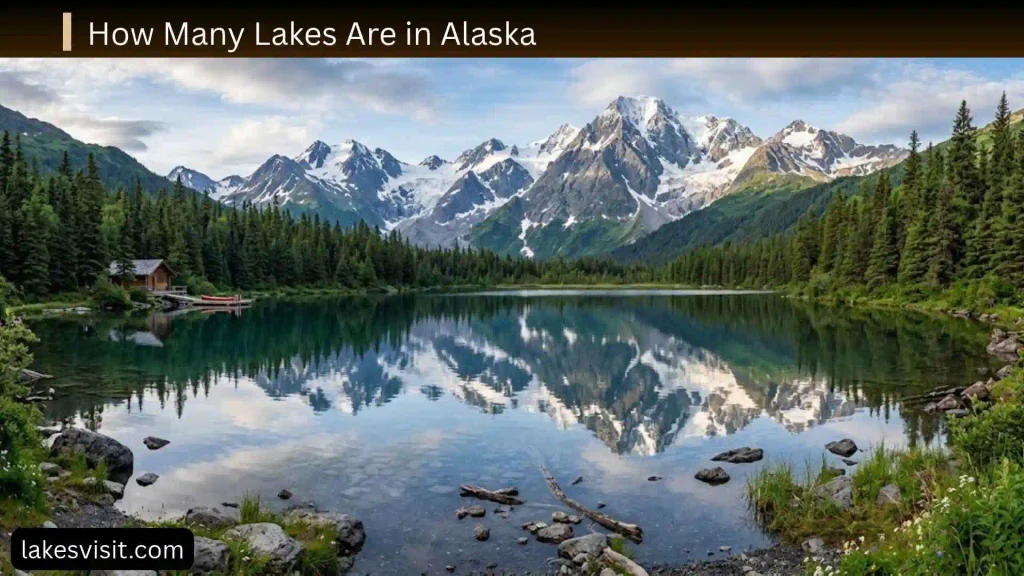
Alaska has more than 3 million lakes, according to the state’s Department of Natural Resources. Alaska Department of Fish and Game also describes approximately 3 million lakes greater than 5 acres.
That number is enormous, but it should not be interpreted as a universal census in which every water body is counted using exactly the same definition.
How Alaska Counts Its Lakes
The number of lakes reported for Alaska depends partly on the minimum size and mapping method used.
For example, Alaska Fish and Game’s description refers to lakes greater than 5 acres, while specific mapping databases can use different thresholds for particular purposes. The department’s Alaska Lake Database is designed to provide information about many fishable lakes, including location, access, characteristics, and stocking information.
This is why it is better to say “more than 3 million lakes” rather than presenting 3 million as an exact permanent count.
It also explains why different websites can publish slightly different numbers without necessarily contradicting each other.
Why Alaska Has More Than 3 Million Lakes
Alaska’s extraordinary lake count comes from a combination of its enormous geographic area, glacial history, geology, permafrost, precipitation, snowmelt, and drainage systems.
Glaciers have played a particularly important role. As glaciers move across the landscape, they can carve valleys, erode bedrock, create depressions, and leave behind deposits that alter drainage patterns.
Alaska also contains extensive permafrost regions where thawing ground ice can create depressions that fill with water. Alaska Department of Fish and Game’s lake-origin classification identifies both glacial and thermokarst lakes, among other types.
The result is an exceptionally varied lake landscape rather than one dominated by a single type of lake.
What Is the Largest Lake in Alaska?
Iliamna Lake is Alaska’s largest lake. The Alaska Department of Natural Resources lists its area as 1,115 square miles.
Because different agencies and references may use different measurements or definitions of a lake’s surface area, figures for Iliamna can vary between sources. For a consistent basic state statistic, the current Alaska DNR figure is the clearest figure to use.
Iliamna Lake
Iliamna Lake is located in southwestern Alaska and forms a major part of the Bristol Bay drainage system.
It is not simply large in surface area. The lake and its connected rivers are also important to Alaska’s fish and wildlife.
The Kvichak River drains Iliamna Lake toward Bristol Bay, and the system provides habitat important to salmon. Alaska Fish and Game identifies the Iliamna drainage as significant for Chinook, coho, and sockeye salmon.
Iliamna’s combination of size, wilderness scenery, fishing, wildlife, and remote access makes it one of the most significant lakes in Alaska.
Other Major Alaska Lakes
Alaska contains many other large and important lakes.
| Lake | Why It Is Notable |
| Iliamna Lake | Alaska’s largest lake |
| Becharof Lake | One of Alaska’s major large lakes |
| Teshekpuk Lake | Major Arctic lake on the North Slope |
| Naknek Lake | Important Bristol Bay-area lake |
| Tustumena Lake | Major lake on the Kenai Peninsula |
| Kenai Lake | Scenic lake in Southcentral Alaska |
| Skilak Lake | Large lake connected with the Kenai River system |
| Lake Minchumina | Major Interior Alaska lake |
| Lake Clark | Large lake associated with Lake Clark National Park and Preserve |
Exact rankings can vary between datasets because lake boundaries, surface-area measurements, and classification methods are not always identical.
Major and Famous Lakes in Alaska
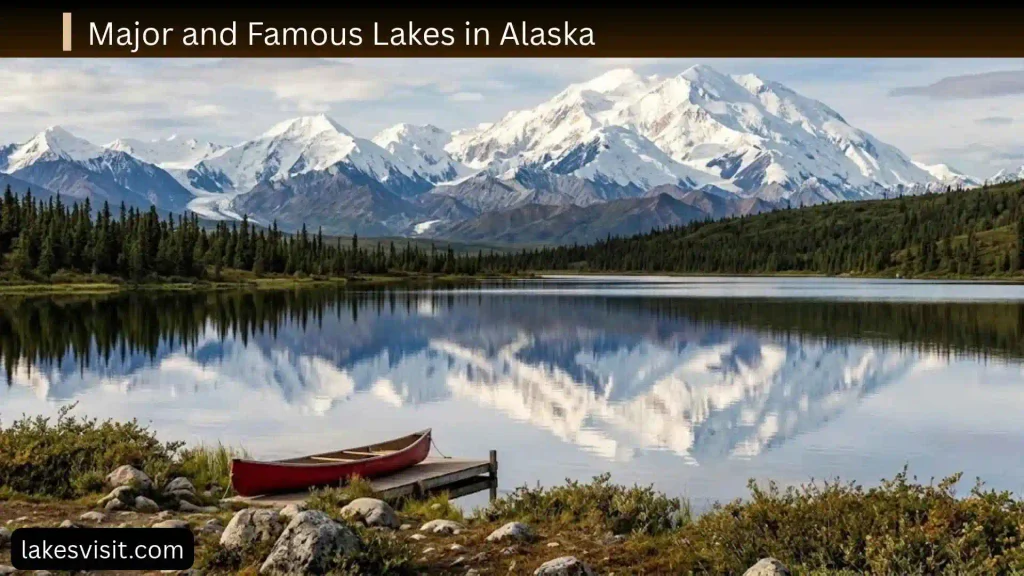
Alaska’s famous lakes are notable for different reasons. Some are among the state’s largest, some are important for fishing and wildlife, and others are popular because they are relatively accessible.
Kenai Lake
Kenai Lake is one of the best-known lakes on the Kenai Peninsula.
The lake sits within a mountainous landscape of forests, rivers, and glaciers, making the surrounding region especially attractive for sightseeing and outdoor recreation.
It is also part of a larger freshwater network that includes the Kenai River and other lakes in the region.
For visitors who want dramatic scenery without traveling deep into Alaska’s most remote wilderness, the Kenai Peninsula offers some of the state’s more accessible lake environments.
Skilak Lake
Skilak Lake is another major lake on the Kenai Peninsula.
Its setting combines large freshwater, mountains, forests, and abundant wildlife habitat. The lake is associated with the Kenai River drainage and lies within an area known for fishing and outdoor recreation.
Its location makes it particularly interesting for visitors who want to combine lake scenery with the broader recreational opportunities of the Kenai Peninsula.
Teshekpuk Lake
Teshekpuk Lake is one of Alaska’s most notable Arctic lakes.
It lies on the North Slope, where the landscape is dramatically different from the forested and mountainous environments around Anchorage and the Kenai Peninsula.
The surrounding region contains numerous smaller lakes and extensive wetland and tundra habitats. Alaska Fish and Game identifies Teshekpuk Lake as one of Alaska’s major lakes and notes the abundance of smaller lakes across the North Slope.
Its Arctic location also makes it important for understanding northern Alaska’s wildlife and freshwater ecosystems.
Eklutna Lake
Eklutna Lake is a popular lake in the Anchorage area and is much more accessible than many remote Alaska lakes.
Its proximity to Anchorage makes it useful for visitors who want to experience Alaska’s mountain-and-lake scenery without arranging a remote flight.
The surrounding area provides opportunities for outdoor recreation, including hiking and camping.
Wood-Tikchik Lakes
The Wood-Tikchik Lakes system is another important part of Alaska’s lake landscape.
Rather than consisting of a single famous lake, the system includes a group of large interconnected lakes in western Alaska. Its remote setting provides an excellent example of how Alaska’s freshwater environments can occur across enormous wilderness areas.
The Alaska Wildlife Action Plan identifies the Wood-Tikchik system as consisting of 13 lakes, illustrating the scale and complexity of some of Alaska’s lake regions.
How Did Alaska’s Lakes Form?
There is no single explanation for all Alaska lakes.
Different lakes formed through different combinations of glacial activity, permafrost processes, river activity, volcanic processes, and other geological changes.
Glacial Lakes
Glacial processes are one of the most important explanations for Alaska’s lake abundance.
As glaciers move, they can scrape and grind against bedrock. They can carve valleys and basins, transport enormous amounts of sediment, and alter drainage systems.
When the ice retreats, water from snow, rain, glaciers, and surrounding drainage can collect in the depressions left behind.
Alaska Fish and Game’s lake classification includes several glacial lake types, including cirque lakes, kettle lakes, ice-dammed lakes, and moraine lakes.
This means “glacial lake” is not a single formation process. Different glacial environments can create different types of lakes.
Permafrost and Thermokarst Lakes
Permafrost is another important part of Alaska’s lake story.
In areas containing frozen ground, the melting of ground ice can cause the surface to collapse or subside. Water can then collect in the resulting depression.
These are commonly referred to as thermokarst or thaw lakes.
Alaska Fish and Game describes thaw lakes as forming when ground ice melts in permafrost areas, causing soil to collapse and allowing water to occupy the resulting depression.
This process is particularly relevant to Arctic and western Alaska.
River and Floodplain Lakes
Some Alaska lakes are connected to rivers and floodplains.
Rivers can change their channels, deposit sediment, and leave behind isolated or partially connected water bodies. Seasonal flooding can also connect lakes, wetlands, and river systems.
These lakes can be particularly important for fish and wildlife because they form part of larger freshwater networks.
Volcanic and Other Lakes
Not all Alaska lakes are purely glacial or thermokarst.
Alaska’s geological diversity includes volcanic landscapes, mountain environments, coastal plains, and river systems. These conditions can produce different types of basins capable of holding water.
This variety is one reason Alaska’s lakes can look so different from one region to another.
Where Are Alaska’s Lakes Located?
Alaska’s lakes are distributed across virtually every major geographic region of the state.
Interior Alaska
Interior Alaska contains enormous numbers of lakes across forests, lowlands, wetlands, and river drainages.
The region also contains many stocked fishing lakes. Alaska Fish and Game describes more than 90 stocked lakes in the Tanana drainage, ranging from roadside lakes to remote lakes accessible by ATV, snowmachine, or floatplane.
Southcentral Alaska
Southcentral Alaska includes many of the state’s best-known recreational lakes.
The Anchorage area, Mat-Su Valley, Kenai Peninsula, and surrounding mountain regions contain lakes that are used for fishing, boating, camping, hiking, and wildlife viewing.
Alaska Fish and Game maintains information on numerous stocked lakes in this region, including 89 lakes in its Northern Cook Inlet Management Area that are stocked on annual, biennial, or triennial schedules.
Southwest Alaska
Southwest Alaska contains some of the state’s largest and most remote lake systems.
The Iliamna and Bristol Bay region is particularly important because its lakes, rivers, and tributaries support major salmon ecosystems.
Many lakes in this region are difficult to reach by road, so floatplanes and boats are important forms of transportation.
Arctic Alaska
Northern Alaska contains extensive networks of shallow lakes and wetlands.
The North Slope is especially well known for its abundance of small lakes and water bodies spread across the tundra.
Some are inaccessible by road, and Alaska Fish and Game notes that certain North Slope lakes are too shallow to support fish populations.
This demonstrates an important point: not every Alaska lake is a fishing lake.
Can You Fish in Alaska Lakes?
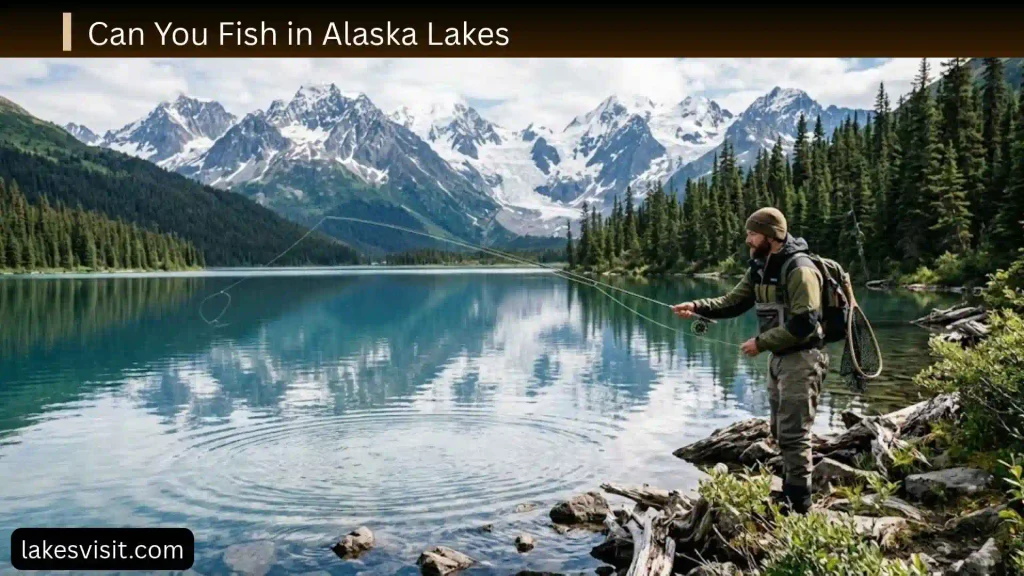
Yes. Fishing is one of the most popular recreational uses of Alaska’s lakes.
However, the fishing experience varies considerably from lake to lake. Some waters contain naturally reproducing fish populations, while others are stocked specifically to provide recreational fishing opportunities.
Alaska Fish and Game maintains a lake database and stocking resources that allow anglers to research lakes, fish species, access information, and stocking records.
Common Fish Species
Depending on the lake and region, anglers may encounter species such as:
- Rainbow trout
- Lake trout
- Arctic char
- Arctic grayling
- Landlocked coho salmon
- Landlocked Chinook salmon
- Northern pike
- Other native freshwater fish
The exact species available depends on the individual lake and its connection to surrounding rivers and watersheds.
Stocked Lakes
Alaska actively stocks selected lakes to provide additional recreational fishing opportunities.
The Alaska Department of Fish and Game says it stocks species including rainbow trout, Arctic char, and landlocked coho and Chinook salmon in lakes and streams around the state.
The department also reports that nearly 300 lakes in Southeast, Southcentral, and Interior Alaska are periodically stocked with hatchery-produced fish.
Stocked lakes can be particularly useful for beginners and families because some are located near roads and population centers.
Remote Fishing Lakes
Not every fishing destination is roadside.
The Tanana drainage, for example, includes roadside lakes as well as remote lakes accessible only by ATV, snowmachine, or floatplane. Alaska Fish and Game notes that remote lakes can provide opportunities for larger fish, while roadside lakes may offer easier access and higher success rates.
Before fishing any Alaska lake, check the current regulations for that specific area. Seasons, bag limits, gear restrictions, and special regulations can change.
Alaska Lakes and Wildlife
Alaska’s lakes are important not only for people but also for wildlife.
A lake is often part of a much larger ecosystem connecting freshwater, wetlands, rivers, forests, tundra, and coastal environments.
Fish and Salmon Habitat
Many Alaska lakes provide habitat for fish throughout different stages of their life cycles.
Some lakes are connected to salmon-bearing rivers, allowing fish to move between lakes and streams.
The Alaska Anadromous Waters Catalog is used to identify waters important for the spawning, rearing, or migration of anadromous fish.
This connectivity makes individual lakes part of larger ecological systems rather than isolated bodies of water.
Birds and Mammals
Lakes and surrounding wetlands can provide feeding, nesting, resting, and migration habitat for birds.
They can also contribute to habitat used by moose, bears, wolves, and other terrestrial animals.
Wildlife activity varies greatly by region and season, but visitors should remember that remote Alaska lakes can be true wilderness environments.
How Can You Visit Alaska Lakes?
Accessibility is one of the biggest differences between Alaska lakes.
Some are located beside major highways, while others are separated from the road network by mountains, rivers, wetlands, or vast wilderness.
Road-Accessible Lakes
Some lakes can be reached by paved or gravel roads and are suitable for day trips.
Road-accessible lakes are particularly common around population centers such as Anchorage, Fairbanks, and the Mat-Su Valley.
These are often the easiest choices for visitors who want hiking, camping, fishing, or boating without arranging specialized transportation.
Boat Access
Some lakes are accessible by boat from connected rivers or roads.
Boat access can open up larger areas of a lake and provide opportunities to reach less crowded shorelines.
However, visitors should understand the lake’s conditions, boat-launch options, weather, and local regulations before setting out.
Fly-In Lakes
Floatplanes are an important way to reach many remote Alaska lakes.
In some parts of the state, flying is the only practical way to reach a lake or fishing lodge.
Alaska Fish and Game specifically identifies remote stocked lakes that require floatplanes, while other remote lakes can require combinations of ATV, snowmachine, hiking, and boating.
Remote Wilderness Lakes
Some Alaska lakes have little or no conventional visitor infrastructure.
These destinations can offer exceptional solitude, but they also require much greater preparation.
Travelers should plan for limited communication, changing weather, cold water, wildlife encounters, and potentially long distances from emergency services.
Alaska Lakes in Summer and Winter
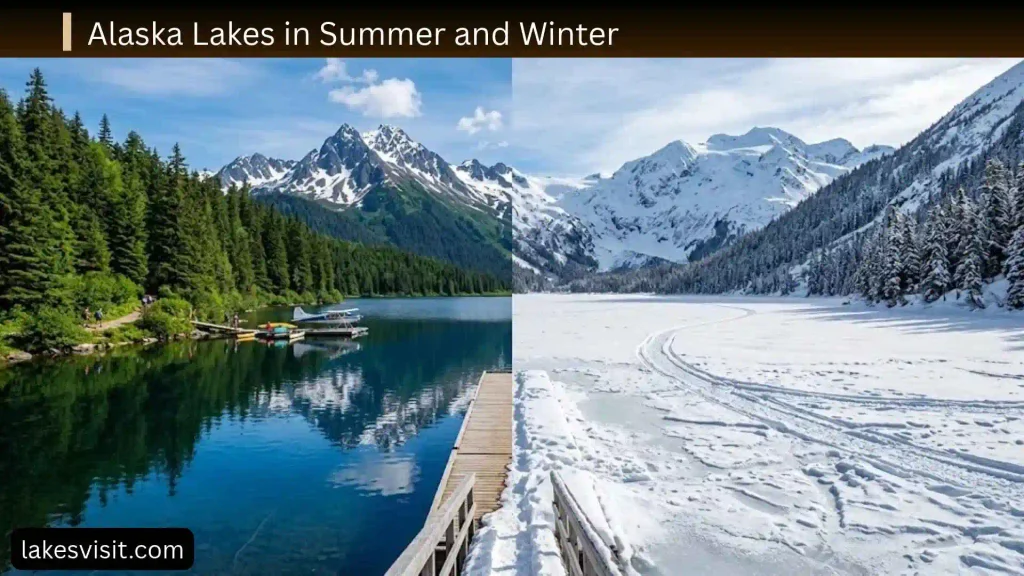
Alaska’s lakes change dramatically with the seasons.
Summer Activities
Summer is generally the most accessible season for many Alaska lakes.
Depending on the location, visitors may enjoy:
- Fishing
- Kayaking
- Canoeing
- Boating
- Hiking
- Camping
- Photography
- Wildlife viewing
Long daylight hours can make summer especially attractive for outdoor activities.
However, conditions vary considerably across Alaska. A lake near Anchorage can have a very different summer climate and access situation from a remote Arctic lake.
Winter Ice and Fishing
Many Alaska lakes freeze during winter, particularly in Interior and northern areas.
Ice fishing is a popular winter activity on suitable lakes. Alaska Fish and Game provides information about stocked lakes and winter fishing opportunities, including Interior lakes that can be reached by snowmachine during winter.
Frozen lakes can provide access to places that are difficult to reach during summer, but ice conditions should never be assumed to be safe simply because a lake appears frozen.
Check local conditions and official guidance before traveling onto lake ice.
Where Can You Find an Alaska Lakes Map?
If you are trying to locate a particular lake, an interactive map is more useful than a simple list.
The Alaska Department of Fish and Game’s Alaska Lake Database provides lake information and mapping resources for many Alaska lakes. The department’s Maps & GIS section identifies the Alaska Lake Database as a featured mapping resource.
The database can be particularly useful for anglers because it can provide information related to lake location, access, stocking, and other characteristics.
For broader geographic research, Alaska’s GIS resources can also help identify lakes, rivers, wildlife areas, and other geographic features.
How to Explore Alaska Lakes Safely
Alaska lake travel can range from an easy afternoon outing to a serious wilderness expedition.
Before visiting a lake, consider:
- Weather conditions
- Road and trail conditions
- Lake access
- Boat-launch availability
- Water temperature
- Wildlife activity
- Fishing regulations
- Fire restrictions
- Emergency communication
- Cell-service availability
- Food and water requirements
- Ice conditions during winter
Cold water is an important consideration even during summer.
Remote lakes may also have no nearby medical facilities, cell coverage, or conventional transportation.
The farther a lake is from a population center, the more important preparation becomes.
Frequently Asked Questions
How many lakes are in Alaska?
Alaska has more than 3 million lakes, according to the Alaska Department of Natural Resources. Alaska Fish and Game describes approximately 3 million lakes greater than 5 acres.
What is the largest lake in Alaska?
Iliamna Lake is Alaska’s largest lake. The Alaska Department of Natural Resources lists its area as approximately 1,115 square miles.
What are the biggest lakes in Alaska?
Major Alaska lakes include Iliamna Lake, Becharof Lake, Teshekpuk Lake, Naknek Lake, Lake Clark, Tustumena Lake, Kenai Lake, and Skilak Lake. Exact rankings can vary depending on the dataset and surface-area measurements used.
What are the most famous lakes in Alaska?
Some of the best-known Alaska lakes include Iliamna Lake, Kenai Lake, Skilak Lake, Teshekpuk Lake, Eklutna Lake, Lake Clark, and the lakes of the Wood-Tikchik system.
Why does Alaska have so many lakes?
Alaska’s huge land area, glacial history, permafrost, geology, precipitation, snowmelt, and drainage systems all contribute to its enormous number of lakes. Glacial processes and permafrost-related lake formation are particularly important in different parts of the state.
How were Alaska’s lakes formed?
Alaska’s lakes formed through several processes. Glacial erosion created and reshaped many basins, while melting ground ice can produce thermokarst lakes. River processes, volcanic activity, and other geological changes have also contributed to lake formation.
Can you fish in Alaska lakes?
Yes. Many Alaska lakes support recreational fishing, including lakes containing rainbow trout, Arctic char, Arctic grayling, lake trout, and landlocked salmon. The Alaska Department of Fish and Game also stocks selected lakes with hatchery-raised fish.
What fish live in Alaska lakes?
Depending on the location, Alaska lakes can contain rainbow trout, lake trout, Arctic char, Arctic grayling, landlocked coho and Chinook salmon, northern pike, and other fish species. Individual lakes can have very different fish communities.
Are all Alaska lakes good for fishing?
No. Not every Alaska lake contains significant fish populations. Some lakes are too shallow, isolated, or otherwise unsuitable for fish. The North Slope, for example, contains many lakes that are inaccessible by road and some that are too shallow to support fish populations.
Are Alaska lakes frozen in winter?
Many Alaska lakes freeze during winter, especially in Interior and northern regions. Ice fishing is popular on suitable lakes, but ice thickness and safety conditions can vary significantly.
Can you swim in Alaska lakes?
Swimming is possible in some Alaska lakes during warmer months, but many lakes remain cold even in summer. Remote lakes may also have no lifeguards or nearby emergency services, so water temperature, weather, access, and local conditions should be considered carefully.
Are Alaska lakes accessible by road?
Some are, but many are not. Alaska has roadside lakes near major communities as well as remote lakes accessible only by boat, ATV, snowmachine, hiking, or floatplane.
Where can I find an Alaska lakes map?
The Alaska Department of Fish and Game provides an Alaska Lake Database through its Maps & GIS resources. It can be used to research many lakes and provides information useful for fishing and access planning.
What is the best Alaska lake to visit?
There is no single best lake for everyone. Iliamna is an excellent choice for a huge wilderness and fishing environment, Kenai and Skilak are attractive for Southcentral scenery and recreation, Eklutna is useful for visitors near Anchorage, and Teshekpuk offers a distinctly Arctic lake environment.
What is the most remote lake in Alaska?
There is no universally recognized single “most remote” lake in Alaska. The state contains thousands of lakes far from roads and communities, and accessibility depends on the region, season, weather, and available transportation.
Are Alaska lakes natural?
Most of Alaska’s famous lakes are natural, but lake classification can vary between datasets. Alaska’s lake landscape includes glacial, thermokarst, river-related, volcanic, and other naturally formed lakes. Fish stocking also occurs in selected lakes, but stocking does not mean that the lake itself is artificial.
Conclusion
Alaska has more than 3 million lakes, making its freshwater landscape one of the state’s defining geographic characteristics. The exact number depends on the size threshold and mapping method used, but official Alaska sources consistently describe a lake-rich landscape on an extraordinary scale.
Iliamna Lake is Alaska’s largest lake, while other major lakes such as Becharof, Teshekpuk, Naknek, Lake Clark, Tustumena, Kenai, and Skilak demonstrate the variety and scale of Alaska’s freshwater systems.
The reason Alaska has so many lakes is equally fascinating. Glacial erosion has created countless basins, while permafrost processes, rivers, geology, and other forces have produced additional lake environments. Alaska Fish and Game’s classification includes several distinct glacial and thermokarst lake types.
For visitors, Alaska lakes offer far more than scenery. Depending on the location, they provide fishing, boating, hiking, camping, wildlife viewing, photography, and winter recreation. Some are easily accessible from roads, while others require boats, snowmachines, ATVs, or floatplanes.
Whether you’re searching for the largest Alaska lakes, famous lakes, fishing lakes, an Alaska lakes map, or simply an explanation of why the state has millions of lakes, Alaska’s freshwater landscape offers an enormous range of destinations and ecosystems to explore.