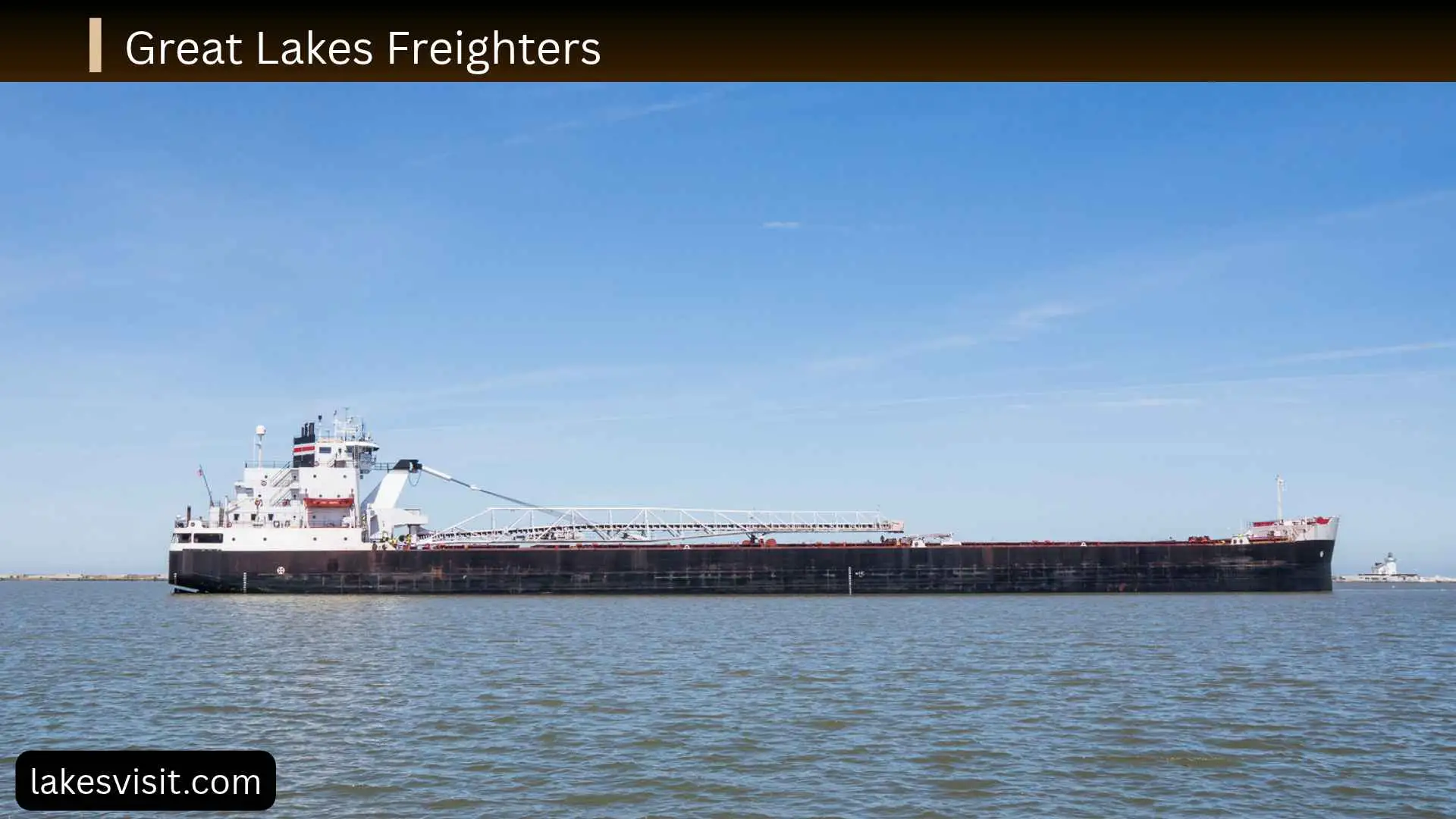
Great Lakes freighters are large cargo ships designed to move bulk materials across the Great Lakes and the connected waterways of the Great Lakes–St. Lawrence system. Often called lakers, these vessels transport essential commodities such as iron ore, limestone, coal, cement, salt, sand and grain.
The largest Great Lakes freighters can carry more than 70,000 tons of cargo on a voyage, while some stretch beyond 1,000 feet in length. Their unusual size and shape are the result of decades of shipbuilding adapted to the lakes, navigation channels, locks and freshwater conditions.
Great Lakes freighters are still an important part of the region’s transportation network. In 2025, U.S.-flag lakers moved about 71.3 million tons of cargo, including 39.1 million tons of iron ore and 20.1 million tons of limestone.
What Are Great Lakes Freighters?
Great Lakes freighters are commercial cargo vessels that operate primarily on the Great Lakes and their connecting waterways. Many are specially designed for the dimensions, weather and freshwater conditions found in the region.
The term Great Lakes freighter can describe several types of commercial vessels, but the word laker is especially important. Lakers are built specifically for Great Lakes and Seaway service and generally remain within the system.
The Great Lakes–St. Lawrence waterway includes the five Great Lakes, connecting channels, canals and the St. Lawrence River. Commercial shipping serves more than 100 ports in the Great Lakes states and the Canadian provinces of Ontario and Quebec.
What Is a Laker?
A laker is a vessel designed primarily for transportation within the Great Lakes and Seaway system.
Lakers have several characteristics that make them different from conventional ocean-going cargo ships. Their hulls and dimensions are designed around the limitations of the inland waterway, while their cargo systems are optimized for bulk commodities.
Many lakers have relatively straight vertical sides and a distinctive bow shape. Some are also equipped with self-unloading systems that allow cargo to move directly from the ship to shore through a conveyor and unloading boom.
Lakers vs. Salties
Not every large ship seen on the Great Lakes is a laker.
Salties are ocean-going vessels capable of traveling between the Great Lakes and overseas ports through the St. Lawrence Seaway. Unlike lakers, salties are designed to withstand open-ocean conditions and may carry bulk, breakbulk or project cargo.
| Feature | Lakers | Salties |
| Primary operating area | Great Lakes and Seaway | Great Lakes plus ocean routes |
| Main design purpose | Inland Great Lakes cargo | Ocean and international trade |
| Hull style | Optimized for Great Lakes/Seaway limits | Ocean-going design |
| Typical cargo | Dry bulk commodities | Bulk, breakbulk and project cargo |
| Can travel overseas? | Generally no | Yes |
There is also a third category: tug-propelled barges, in which a tug is fitted into or connected with a specially designed barge. These units can transport different types of cargo depending on the barge configuration.
What Do Great Lakes Freighters Carry?
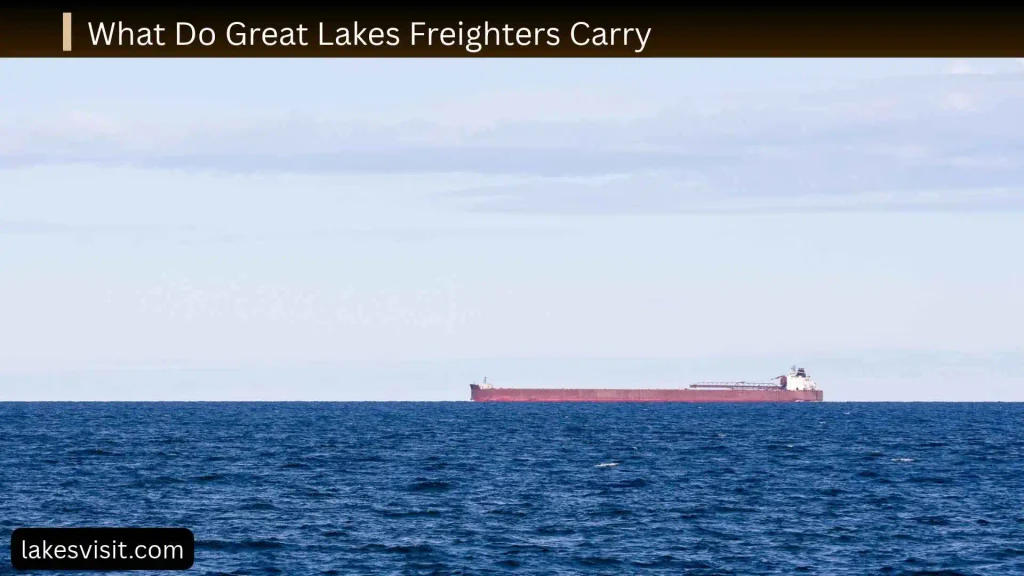
The main purpose of Great Lakes freighters is to move large quantities of bulk cargo efficiently between mines, ports, industrial facilities and manufacturing centers.
The cargo mix changes from year to year, but major commodities include iron ore, limestone, coal, cement, salt, sand and grain.
Iron Ore and Taconite
Iron ore is one of the most important commodities transported by Great Lakes freighters.
Lakers move ore and processed taconite pellets from mining regions toward ports and steelmaking facilities. In 2025, U.S.-flag lakers carried approximately 39.1 million tons of iron ore.
This trade is particularly important because the Great Lakes provide a waterborne link between mining areas and industrial centers around the lakes.
Limestone and Stone
Limestone is another major Great Lakes cargo.
It is used in industries including steelmaking, construction and cement production. U.S.-flag lakers carried about 20.1 million tons of limestone in 2025, while total Great Lakes limestone shipments from U.S. and Canadian quarries reached about 26.6 million tons.
Grain and Farm Products
Grain is also transported through the Great Lakes and St. Lawrence system.
Water transportation gives agricultural producers and exporters access to ports connected with wider domestic and international markets. Grain volumes are generally much smaller than iron ore and limestone volumes in the U.S.-flag laker fleet, but they remain part of the system’s diverse cargo mix.
Coal, Salt and Cement
Coal, salt and cement are other important cargoes.
In 2025, U.S.-flag lakers moved approximately 6.5 million tons of coal, 3.5 million tons of cement and 1.3 million tons of salt. Salt was notable because it was the only major commodity category in the LCA’s 2025 year-in-review report to increase compared with 2024.
Steel and Other Cargo
The broader Great Lakes–St. Lawrence system also handles steel, breakbulk and project cargo.
This is where the distinction between lakers and salties becomes useful. Ocean-going vessels can bring international cargo into the Great Lakes, while domestic lakers are especially important for moving dry bulk commodities within the region.
How Big Are Great Lakes Freighters?
Great Lakes freighters range from relatively small cargo vessels to enormous 1,000-foot-class ships.
The largest lakers are among the longest commercial vessels operating on the Great Lakes. Several vessels listed by the Lake Carriers’ Association are approximately 1,000 feet long, with carrying capacities above 68,000 tons.
1,000-Foot Great Lakes Freighters
The 1,000-foot freighters are a defining feature of modern Great Lakes shipping.
For example, the Lake Carriers’ Association lists several vessels at approximately 1,000 feet long and 105 feet wide. The Paul R. Tregurtha is listed at 1,013 feet, while vessels such as the Edwin H. Gott and Edgar B. Speer are listed at 1,004 feet.
These ships are extremely long compared with their beam, giving them a distinctive narrow profile.
How Much Cargo Can a Great Lakes Freighter Carry?
Cargo capacity depends on the vessel, draft, cargo type and operating conditions.
The largest Great Lakes freighters can carry more than 70,000 tons of cargo, according to the American Great Lakes Ports Association. The Lake Carriers’ Association fleet data shows several 1,000-foot-class vessels with capacities in the high-60,000-ton range and some above 70,000 tons.
For perspective, the American Great Lakes Ports Association says the cargo carried by the largest vessels can be equivalent to the loads of roughly 700 rail cars or 2,800 trucks.
Why Are Great Lakes Freighters So Long?
Their length is closely related to the economics and physical limitations of Great Lakes shipping.
A long, relatively narrow ship can carry a very large cargo while remaining within important width and draft limitations. However, the largest lakers are not able to travel everywhere in the Great Lakes system.
The 1,000-foot vessels are too large for the Welland Canal and therefore operate primarily in the upper four Great Lakes. Their ability to move between Lake Superior and the lower Great Lakes depends on the Poe Lock at Sault Ste. Marie.
How Do Great Lakes Freighters Work?
Although their primary job is simple—carry cargo from one port to another—the design of Great Lakes freighters involves specialized cargo-handling and navigation systems.
Self-Unloading Freighters
Many Great Lakes freighters are self-unloaders.
Instead of requiring a large shore-based crane to remove all the cargo, a self-unloading vessel uses an internal conveyor system and an unloading boom. The boom can extend over the dock while the conveyor carries bulk material from the cargo holds toward shore.
This system can significantly reduce the time required to unload cargo and allows ships to serve ports equipped to receive material directly from the vessel.
The M/V Paul R. Tregurtha, for example, has a self-unloading system and a 260-foot boom. Interlake Steamship says the vessel can empty its five cargo holds in about eight hours.
Loading and Unloading Cargo
A typical Great Lakes cargo trip involves several stages:
- The vessel arrives at a loading port.
- Bulk material is loaded into its cargo holds.
- The ship travels to the destination port.
- Cargo is transferred using the vessel’s unloading system or shore-side equipment.
- The empty or partially loaded vessel begins another voyage.
Because Great Lakes shipping often involves repetitive movements of commodities such as ore and stone, ships can operate on established trade routes between particular loading and unloading facilities.
How Do Freighters Handle Draft and Channel Limits?
A ship’s draft is the vertical distance between the waterline and the lowest part of the vessel.
Draft is important because Great Lakes freighters operate in channels and locks with specific depth limitations. A ship cannot simply load as much cargo as possible without considering water depth, route restrictions and other operating requirements.
The St. Lawrence Seaway maintains channels to a minimum depth of 27 feet, while Seaway vessels have defined maximum dimensions.
How Do Great Lakes Freighters Navigate?
Great Lakes freighters operate within a highly engineered waterway that includes natural lakes, rivers, canals, channels and locks.
The locks are essential because the Great Lakes are not all at the same elevation.
Soo Locks
The Soo Locks at Sault Ste. Marie, Michigan, provide the connection between Lake Superior and Lake Huron.
The locks allow ships to bypass the rapids of the St. Marys River and overcome an elevation difference between the two lakes. The Poe Lock is especially important for 1,000-foot Great Lakes freighters because its dimensions allow these large vessels to pass between Lake Superior and the other Great Lakes.
The Poe Lock is 1,200 feet long, 110 feet wide and 32 feet deep, making it substantially larger than the locks of the St. Lawrence Seaway.
Welland Canal
The Welland Canal provides a route between Lake Ontario and Lake Erie.
It crosses the Niagara Peninsula and allows ships to bypass Niagara Falls. The canal has eight navigation locks and raises or lowers vessels through a total elevation difference of about 326.5 feet.
This is why the Welland Canal is critical to vessels traveling between the eastern Great Lakes.
However, the largest 1,000-foot U.S. lakers are too large for the Welland Canal. This creates an important distinction between the upper-lake laker fleet and smaller Seaway-sized vessels.
St. Lawrence Seaway
The St. Lawrence Seaway connects the Great Lakes system with the Atlantic Ocean through the St. Lawrence River.
The system includes the Welland Canal and the Montreal–Lake Ontario section. Together, the locks allow ships to overcome the elevation difference between Montreal and Lake Erie while providing access to the Great Lakes.
Standard Seaway dimensions are an important limitation. The system lists a maximum vessel length of 740 feet and maximum beam of 78 feet for routine Seaway navigation, although specific operating requirements and vessel approvals can affect individual transits.
Great Lakes Freighters and Winter Shipping
Winter creates one of the most distinctive challenges for Great Lakes shipping.
Ice can affect channels, harbors and waterways, especially in the upper Great Lakes. Shipping operations therefore have to account for seasonal conditions, ice coverage, vessel capabilities and navigation support.
Do Great Lakes Freighters Operate in Winter?
Great Lakes shipping does not simply follow one universal start and stop date every year.
Winter conditions vary by location and season. Ice can slow or complicate navigation, while icebreaking and vessel preparation can help maintain access to important ports and channels.
The Lake Carriers’ Association identifies adequate icebreaking as an important issue for Great Lakes ports and commercial navigation.
For that reason, winter navigation is better understood as a combination of weather, ice conditions, vessel capabilities, port conditions and navigation requirements rather than a fixed annual schedule.
Why Is Ice a Problem for Great Lakes Freighters?
Ice can restrict channels and make maneuvering more difficult.
The freshwater Great Lakes can experience significant seasonal ice, especially in northern and western areas. Ships, ports and navigation authorities must therefore plan around changing conditions.
The Seaway also notes that certain larger-beam vessels can face additional restrictions or delays during periods of ice cover.
Famous Great Lakes Freighters
Some Great Lakes freighters have become famous because of their size, history, engineering or connection to major events.
M/V Paul R. Tregurtha
The M/V Paul R. Tregurtha is one of the most recognizable modern Great Lakes freighters.
Interlake Steamship lists the vessel at 1,013.5 feet long with a beam of 105 feet. It was built in 1981 and can carry up to 68,000 gross tons of taconite pellets or 71,000 net tons of coal, according to the company.
Interlake describes it as the longest ship on the Great Lakes and notes that it is known as the “Queen of the Lakes.”
SS Edmund Fitzgerald
The SS Edmund Fitzgerald is perhaps the most famous Great Lakes freighter in history.
The ship became famous after it sank in Lake Superior during a severe storm in November 1975. Its loss remains one of the best-known maritime disasters associated with the Great Lakes.
Unlike the modern commercial vessels still operating today, the Edmund Fitzgerald is remembered primarily as a historic ship and as part of the region’s maritime history.
M/V Mark W. Barker
The M/V Mark W. Barker represents a more modern chapter in Great Lakes shipping.
Interlake Steamship lists the vessel at 639 feet and identifies it as a 2022-built vessel. The company announced its maiden voyage in July 2022, describing it as the first U.S.-flagged Great Lakes bulk carrier in nearly 40 years and the company’s first new build since 1981.
Its presence demonstrates that Great Lakes shipping is not purely a story about aging historic freighters. New vessels are still being introduced to meet modern transportation needs.
History of Great Lakes Freighters
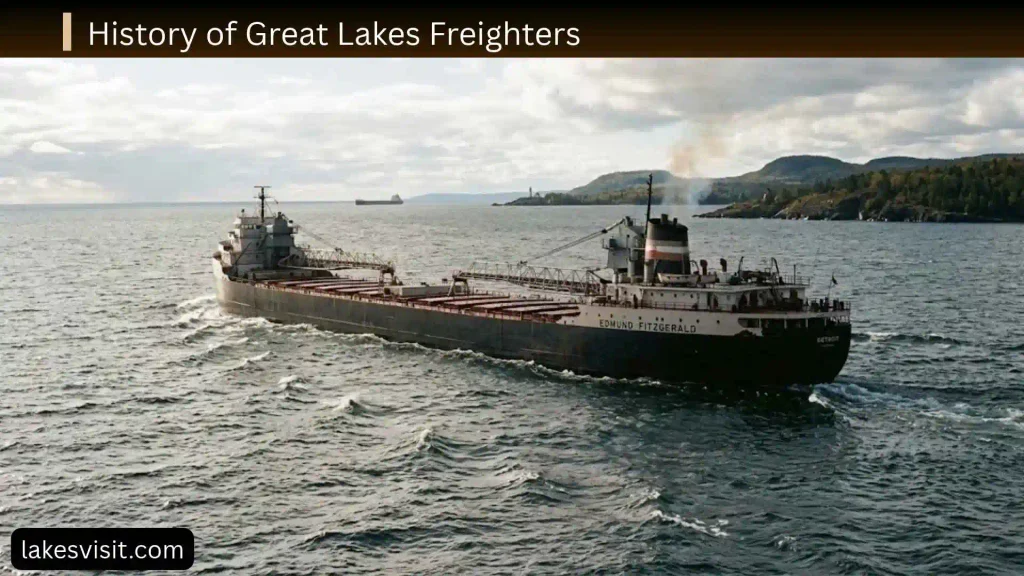
Great Lakes freighters have evolved alongside the industrial development of the Great Lakes region.
Early Great Lakes Shipping
Early commercial vessels on the Great Lakes were much smaller and used different construction methods and propulsion systems than today’s giant lakers.
As industrial activity expanded, demand increased for vessels capable of transporting large quantities of raw materials between ports.
The Great Lakes eventually became a major transportation network connecting mines, farms, ports and industrial centers.
Rise of Steel Freighters
Steel construction allowed shipbuilders to create larger and stronger cargo vessels.
As the iron and steel industries expanded around the Great Lakes, the need for efficient bulk transportation grew as well. Freighters increasingly specialized in carrying heavy commodities such as ore, stone and coal.
Rise of Self-Unloaders
Self-unloading technology transformed Great Lakes cargo handling.
Instead of depending entirely on shore-side unloading equipment, vessels could carry their own conveyor systems and booms. This allowed them to unload bulk cargo efficiently at appropriately equipped facilities.
The 1,000-Foot Era
The development of 1,000-foot freighters represented another major step in Great Lakes ship design.
These vessels could carry enormous quantities of cargo while still operating within the particular constraints of the Great Lakes navigation system.
Their size, however, also limited their routes. The largest lakers cannot use the Welland Canal and rely on the Poe Lock for access between Lake Superior and the lower lakes.
Modern Great Lakes Freighters
Today’s fleet combines older vessels that have remained useful for decades with newer ships designed around modern efficiency and regulatory requirements.
The 2022 arrival of the M/V Mark W. Barker was especially significant because it marked a new U.S.-flagged Great Lakes bulk carrier entering service after a long gap in new construction.
Why Great Lakes Freighters Matter
Great Lakes freighters are more than large ships that move around the lakes. They form an important part of the industrial supply chain.
Supporting Steel and Manufacturing
Iron ore is transported toward steelmaking facilities, while limestone supports steel production, cement manufacturing and construction.
These movements help connect raw-material sources with industrial consumers.
The Lake Carriers’ Association says the U.S.-flag fleet moves more than 90 million tons of cargo annually under normal fleet-capacity descriptions, with cargoes including iron ore, stone, coal, cement, salt, sand and grain.
Connecting Mines, Ports and Industry
A Great Lakes cargo trip can be part of a much larger supply chain.
For example:
Mine or quarry → loading port → Great Lakes freighter → destination port → rail or truck → industrial customer
This intermodal connection is one reason Great Lakes shipping remains important even in an era dominated by highways and railroads.
Moving Bulk Cargo Efficiently
Water transportation is particularly well suited to heavy bulk commodities.
A single large freighter can move tens of thousands of tons of material in one voyage. The American Great Lakes Ports Association notes that the largest Great Lakes vessels can carry cargo equivalent to hundreds of rail cars or thousands of trucks.
Great Lakes Freighters Today
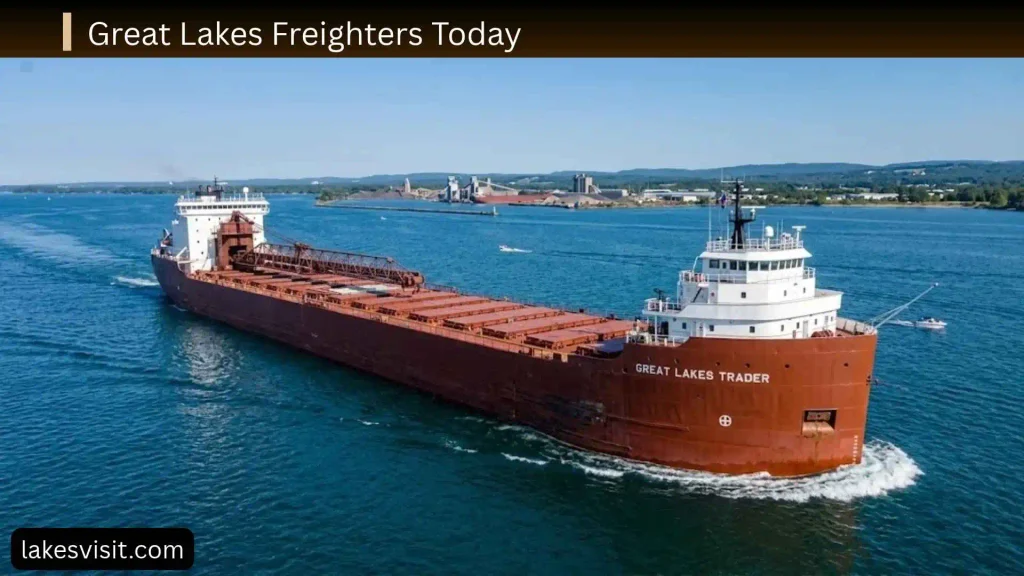
Great Lakes freighters continue to serve commercial ports across the region.
The scale of the modern fleet varies considerably, from smaller vessels to 1,000-foot giants.
How Much Cargo Do Great Lakes Freighters Move Today?
The latest complete annual U.S.-flag data available from the Lake Carriers’ Association shows that lakers carried approximately 71.3 million tons in 2025. That was 8.9% lower than 2024 and 8.1% below the fleet’s five-year average.
Iron ore accounted for about 39.1 million tons and limestone for about 20.1 million tons in the U.S.-flag fleet’s 2025 figures.
These figures can change substantially from year to year because Great Lakes shipping is closely tied to industrial demand, commodity markets, weather and broader economic conditions.
Are Great Lakes Freighters Still Being Built?
Yes.
The M/V Mark W. Barker entered service in 2022 after being constructed as a new U.S.-flagged Great Lakes bulk carrier. Interlake Steamship lists it as 639 feet long with a capacity of about 26,000 gross tons.
At the same time, many older ships remain active. The result is a mixed fleet containing vessels built across several generations.
Where Can You See Great Lakes Freighters?
Great Lakes freighters can be seen at major commercial ports, rivers, locks and heavily traveled shipping routes.
Best Areas for Ship Watching
Popular areas for seeing commercial vessels include:
- Sault Ste. Marie and the Soo Locks
- Duluth-Superior
- Detroit River
- St. Clair River
- Lake Erie shipping areas
- Major Great Lakes commercial ports
- St. Lawrence Seaway communities
The exact vessels visible at any location depend on cargo movements, weather, schedules and navigation conditions.
The Great Lakes–St. Lawrence system serves more than 100 commercial ports, so ship-watching opportunities exist throughout the region.
How to Identify a Great Lakes Freighter
A Great Lakes freighter often has a distinctive profile.
Look for:
- A very long, narrow hull
- Large cargo hatches along the deck
- A high deckhouse, often toward the stern
- A self-unloading boom on many vessels
- A bow designed for Great Lakes navigation
- A large overall length compared with the ship’s width
If the vessel appears unusually long and narrow and is carrying a bulk cargo, there is a good chance you are looking at a lake.
Great Lakes Freighters vs. Ocean Freighters
Great Lakes freighters and ocean-going freighters may both transport cargo, but they are designed for different operating environments.
Key Differences
| Feature | Great Lakes Freighter | Ocean Freighter |
| Primary environment | Lakes and connected waterways | Open ocean |
| Common term | Laker | Ocean-going cargo ship |
| Design priorities | Locks, channels and Great Lakes conditions | Ocean weather and long-distance voyages |
| Typical cargo | Dry bulk | Bulk, containers, breakbulk or other cargo |
| Size limitations | Strongly influenced by Great Lakes infrastructure | Influenced by ocean ports and canals |
| International voyages | Generally limited for lakers | Normal for ocean-going ships |
There is an important exception: salties are ocean-going vessels that can enter the Great Lakes through the St. Lawrence Seaway.
The difference in dimensions is also significant. The Seaway’s maximum routine vessel dimensions are about 740 feet long and 78 feet wide, while some Great Lakes lakers exceed 1,000 feet.
Frequently Asked Questions
What is a Great Lakes freighter?
A Great Lakes freighter is a commercial cargo vessel designed to transport goods across the Great Lakes and connected waterways. Many are called lakers and specialize in bulk cargo such as iron ore, limestone, coal, cement, salt, sand and grain.
What do Great Lakes freighters carry?
Great Lakes freighters primarily carry bulk commodities. Major cargoes include iron ore, limestone, coal, cement, salt, sand and grain. Iron ore and limestone are among the largest cargo categories for the U.S.-flag fleet.
How long is the largest Great Lakes freighter?
The M/V Paul R. Tregurtha is 1,013.5 feet long, according to Interlake Steamship, which describes it as the longest ship on the Great Lakes.
How much cargo can a Great Lakes freighter carry?
The largest Great Lakes freighters can carry more than 70,000 tons of cargo. Individual capacities vary according to ship design, cargo and operating conditions.
Can Great Lakes freighters go into the ocean?
Most traditional lakers are designed primarily for the Great Lakes and Seaway system and rarely leave it. Ocean-going salties, however, are designed to travel between the Great Lakes and overseas destinations through the St. Lawrence Seaway.
Why are Great Lakes freighters so long?
Their long, narrow designs allow them to carry large amounts of cargo while working within the physical constraints of Great Lakes navigation. The largest 1,000-foot lakers are too large for the Welland Canal and therefore operate mainly in the upper four Great Lakes.
What is the difference between a laker and a salty?
A laker is built mainly for Great Lakes and Seaway service, while a salty is an ocean-going vessel capable of traveling between the Great Lakes and international destinations.
What are the Soo Locks used for?
The Soo Locks allow vessels to travel between Lake Superior and Lake Huron by bypassing the rapids of the St. Marys River. The Poe Lock is large enough to accommodate 1,000-foot-class Great Lakes freighters.
Why can’t 1,000-foot Great Lakes freighters use the Welland Canal?
The largest lakers exceed the Welland Canal’s practical size limitations. The Seaway locks accommodate vessels up to about 740 feet long and 78 feet wide under standard maximum dimensions, while 1,000-foot lakers can exceed 1,000 feet in length and 105 feet in beam.
Do Great Lakes freighters operate during winter?
Yes, although winter ice can affect navigation. Shipping conditions vary by location and year, and commercial operators and navigation authorities must account for ice, weather and channel conditions.
Are Great Lakes freighters still important today?
Yes. The U.S.-flag Great Lakes fleet moved about 71.3 million tons of cargo in 2025, demonstrating that lakers remain an important part of the region’s bulk transportation system.
Conclusion
Great Lakes freighters are a unique part of North American maritime transportation. From 1,000-foot lakers carrying tens of thousands of tons to smaller vessels serving specialized routes, these ships connect mines, quarries, farms, ports and industrial centers throughout the Great Lakes region.
Their importance comes from more than their impressive size. Great Lakes freighters are carefully designed around the dimensions of locks and channels, the freshwater environment, seasonal ice and the needs of bulk-cargo transportation.
The largest lakers can carry more than 70,000 tons, while vessels such as the M/V Paul R. Tregurtha demonstrate the scale of modern Great Lakes shipbuilding. At the same time, ships such as the M/V Mark W. Barker show that the fleet continues to evolve.
Whether you are interested in Great Lakes shipping, lake freighter history, famous ships, ship watching or maritime engineering, understanding the difference between lakers and salties—and the role of the Soo Locks, Welland Canal and St. Lawrence Seaway—provides the key to understanding how these remarkable vessels operate.