
Have you ever imagined that a lake could exist beneath the ocean? I was amazed when I first learned that underwater lakes are real, and I am sure you will be just as fascinated. These incredible natural formations look like ordinary lakes with clear shorelines, waves, and even “beaches,” yet they are hidden deep below the sea’s surface.
In this guide, I am going to show you what underwater lakes are, how they form, where they can be found, and why they are so important to scientists. By the end, you will understand the mystery behind these unique underwater worlds and discover why they continue to capture the attention of researchers and explorers around the globe.
What Are Underwater Lakes?
An underwater lake is a distinct body of water located beneath another environment that normally separates it from direct contact with the atmosphere.
The term is used broadly, so not every underwater lake looks or behaves like an ordinary surface lake.
A body of dense brine on the ocean floor can have a lake-like boundary because the water inside it is much saltier and denser than the surrounding seawater. A subglacial lake, on the other hand, can sit between an ice sheet and bedrock, completely hidden beneath kilometers of ice.
Underground cave lakes are another example. These form below the Earth’s surface inside large natural cavities and can be connected to groundwater systems.
The important point is that “underwater lake” is a broad descriptive term rather than one single type of geological feature.
Are Underwater Lakes Real?
Yes, they are real.
Scientists have observed and mapped lake-like bodies of dense brine on the ocean floor, while geophysical surveys have identified large bodies of liquid water beneath ice sheets. These environments are not imaginary or simply optical illusions.
However, they are very different from an ordinary lake surrounded by land.
A seafloor brine pool may be extremely salty, while a subglacial lake can be trapped beneath thick ice. Their unusual locations are what make them seem mysterious.
What Is an Underwater Lake Called?
The terminology depends on where the water is located.
A highly salty body of water on the ocean floor is often called a brine pool. A lake beneath an ice sheet is called a subglacial lake, while a water-filled underground cavity may be described as an underground lake or cave lake.
Therefore, when people search for “underwater lakes,” they may actually be looking for information about several different scientific phenomena.
How Do Underwater Lakes Form?

There is no single formation process because different types of hidden lakes develop in different environments.
How Seafloor Underwater Lakes Form
Some of the best-known underwater lakes occur on the ocean floor as dense brine pools.
The process can begin with salt deposits beneath the seafloor. Seawater can interact with these deposits and dissolve additional salt. As the concentration of dissolved salts increases, the water becomes much denser than ordinary seawater.
Gravity then causes the dense brine to sink and collect in low areas of the seafloor.
If enough brine accumulates in a natural depression, it can form a distinct lake-like body surrounded by normal seawater.
This explains why an underwater lake can have something resembling a shoreline even though it is located beneath the ocean.
How Subglacial Lakes Form
Subglacial lakes form beneath glaciers and ice sheets.
At the bottom of a thick ice sheet, pressure and heat from Earth’s interior can create conditions where ice melts. The resulting water can collect in depressions in the bedrock beneath the ice.
The ice above acts as an insulating layer, while geothermal heat contributes energy from below. Over time, water can accumulate into substantial underground reservoirs. Research on Antarctic subglacial environments shows that these lakes can vary greatly in size and behavior.
How Underground Lakes Form
Underground lakes generally develop where geological structures provide enough space for water to accumulate.
In areas containing soluble rocks such as limestone, groundwater can gradually dissolve portions of the rock. Over long periods, this process can contribute to the formation of caves, chambers, tunnels, and other underground spaces.
Where a large cavity is able to retain water, an underground lake can develop.
These lakes are therefore closely related to cave systems and groundwater movement rather than ocean processes.
Why Don’t Underwater Lakes Mix With Surrounding Water?
This is one of the most interesting questions about underwater lakes.
The answer depends on the type.
For seafloor brine pools, density is the key factor.
Salt dissolved in water increases its density. When brine becomes sufficiently concentrated, it can be considerably denser than the seawater around it. Instead of rapidly spreading upward and mixing throughout the ocean, the dense brine tends to remain close to the seafloor.
A depression in the ocean floor can then act like a natural container.
The Role of Salt
Imagine two liquids with different densities.
The lighter liquid tends to remain above the denser liquid. The same basic principle operates in an underwater brine pool.
The extremely salty water sinks toward the bottom, while ordinary seawater remains above it.
This creates a boundary between the two fluids.
The boundary is not necessarily permanent. Mixing can occur at the edges, but the large difference in density helps maintain the lake-like structure.
Seafloor Depressions
A natural depression makes the process even more effective.
If dense brine flows into a low section of the seafloor, gravity encourages it to remain there. The surrounding terrain can prevent the brine from simply spreading across the ocean floor.
This combination of high salinity, greater density, and suitable seafloor topography is central to the formation of many seafloor brine pools.
Types of Underwater and Hidden Lakes
Although the phrase “underwater lakes” sounds like one category, several types should be distinguished.
Seafloor Underwater Lakes
These are dense bodies of water located beneath the ocean.
Many are brine pools containing extremely salty water. They can occur around areas where salt deposits and geological activity influence the chemistry of seawater.
These environments are particularly interesting because their chemistry can differ dramatically from the surrounding ocean.
Subglacial Lakes
Subglacial lakes exist beneath glaciers or ice sheets.
Antarctica contains the largest concentration of known subglacial lakes. A major scientific inventory identified 773 subglacial lakes worldwide, including 675 in Antarctica, 64 in Greenland, and others beneath Icelandic ice caps, the Devon Ice Cap, and valley glaciers.
These lakes are important because they are connected to ice movement, drainage, sediment processes, and potentially microbial ecosystems.
Underground Lakes
Underground lakes exist beneath Earth’s surface, often inside cave systems or large natural cavities.
Unlike seafloor brine pools, they are not necessarily extremely salty. Their water chemistry depends on the geology, groundwater sources, and surrounding environment.
Some underground lakes can be reached by cave explorers, while others are difficult or impossible for people to access.
Famous Examples of Underwater and Hidden Lakes
Different examples help demonstrate how varied these environments can be.
Gulf of Mexico Brine Pools
The Gulf of Mexico contains some of the best-known examples of lake-like brine bodies beneath the ocean.
These features are associated with ancient salt deposits beneath the seafloor. Highly concentrated brine can collect in depressions, producing underwater environments that resemble lakes.
The surrounding seawater and dense brine have different physical and chemical properties, allowing the brine pool to maintain a recognizable boundary.
These environments are particularly valuable to scientists because they provide natural laboratories for studying extreme chemistry and life.
Lake Vostok
Lake Vostok is one of the most famous subglacial lakes on Earth.
It lies beneath the Antarctic ice sheet and is covered by several kilometers of ice. Scientific studies have used airborne geophysics, radar, seismic observations, and other measurements to determine the lake’s size and structure.
Lake Vostok is enormous. Scientific literature describes it as more than 250 kilometers long, making it vastly different from the small hidden lakes people might imagine when they hear the term “underwater lake.”
Other Antarctic Subglacial Lakes
Lake Vostok is only one example.
Researchers have identified hundreds of other lakes beneath Antarctica. Some are relatively stable, while others are active and can experience changes in water storage and drainage.
This means the Antarctic ice sheet contains a complex hidden hydrological environment rather than isolated pools that never change.
What Do Underwater Lakes Look Like?
Their appearance depends heavily on the environment.
Seafloor Brine Pools
A deep-sea brine pool can look surprisingly lake-like.
Instead of a visible water surface exposed to air, its “surface” is a boundary between dense brine and normal seawater.
The surrounding seafloor may form something resembling a shoreline, creating an underwater landscape that looks very different from the open ocean.
Hidden Lakes Beneath Ice
Subglacial lakes cannot normally be seen directly from above.
Instead, scientists create maps from measurements collected using instruments such as ice-penetrating radar, satellite observations, seismic techniques, and other geophysical methods.
What appears to be a smooth section of ice at the surface can therefore conceal a large body of water many kilometers below.
Underground Cave Lakes
Underground lakes can look more familiar.
Inside caves, water can occupy chambers surrounded by rock. Some may have calm surfaces, while others are connected to rivers, groundwater channels, or flooded cave passages.
What Lives in Underwater Lakes?
One of the biggest scientific questions is whether life can survive in these extreme environments.
Microbial Life
Microorganisms are particularly important because they can survive under conditions that would be difficult for many larger organisms.
Some deep-sea brine environments support microbial communities adapted to high salinity and unusual chemistry.
Subglacial environments are also of interest because they can provide isolated habitats where microorganisms may obtain energy from chemical reactions involving minerals and other materials.
Organisms Around Brine Pools
Some seafloor brine pools have biological communities concentrated around their edges.
The reason is that the boundary between brine and seawater can create a chemically unusual environment. Organisms living there may be adapted to conditions that are unsuitable for most ordinary marine life.
These ecosystems demonstrate that extreme environments do not necessarily mean lifeless environments.
Life Beneath Ice
Subglacial lakes are especially interesting to researchers studying life in isolated environments.
Lake Vostok research has provided evidence relevant to the possibility of microbial life in the lake environment, although direct sampling of the lake itself is challenging. Earlier studies identified microbial material in ice that had frozen onto the underside of the ice sheet above the lake.
Scientists are interested in these environments because they show that darkness, cold, pressure, and isolation do not automatically eliminate the possibility of life.
Can Humans Visit Underwater Lakes?
Not all underwater lakes are accessible to people.
Deep-Sea Lakes
Seafloor brine pools are often located in deep ocean environments.
Extreme pressure, darkness, cold, and unusual water chemistry make them unsuitable for ordinary recreational diving.
Scientists can investigate some of these environments using remotely operated vehicles and other specialized equipment.
Underground Lakes
Some cave lakes can be visited by experienced cave divers or explorers, but accessibility varies enormously.
A cave may contain narrow passages, unstable rock, strong currents, poor visibility, or other hazards.
A lake being physically accessible does not mean it is safe for casual swimming.
Subglacial Lakes
Subglacial lakes are the least accessible category.
A lake beneath several kilometers of Antarctic ice cannot simply be reached with conventional diving equipment.
Scientific investigation requires sophisticated drilling, geophysical surveys, contamination controls, and specialized logistics.
How Scientists Discover Underwater Lakes
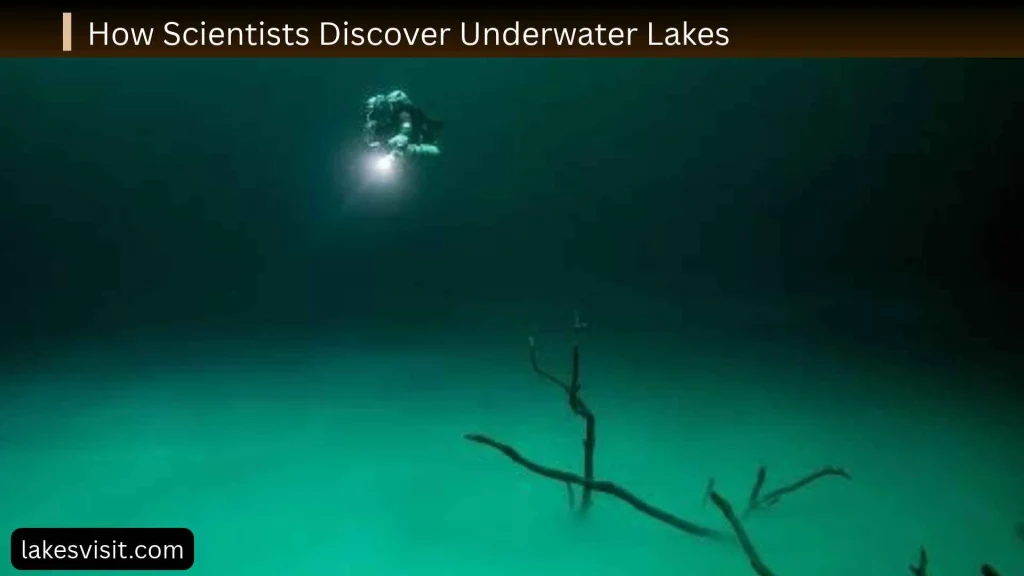
Scientists cannot always see hidden lakes directly, so they use indirect measurements.
Sonar and Seafloor Mapping
On the ocean floor, sonar and other underwater mapping systems can reveal depressions, unusual surfaces, and geological structures.
Researchers can combine these observations with direct measurements from remotely operated vehicles.
Ice-Penetrating Radar
Radar is one of the most important tools for investigating subglacial lakes.
Radar signals can travel through ice and reflect differently when they encounter interfaces involving water, ice, or bedrock.
Repeated surveys can help scientists map the shape and extent of hidden water bodies.
Satellite Technology
Satellites can also reveal clues about water beneath ice.
A subglacial lake can affect the surface of an ice sheet. When water moves or accumulates beneath the ice, the surface above can rise or fall slightly.
By repeatedly measuring the ice surface, researchers can identify changes associated with hidden water movement.
Seismic and Geophysical Surveys
Seismic measurements can provide information about the depth and structure of subglacial environments.
Scientists combine different techniques because no single method provides every piece of information needed to understand a hidden lake.
Do Underwater Lakes Move?
Some do.
This is particularly important for subglacial lakes.
A subglacial lake can receive water and later release it into another part of the drainage system. Scientists describe some of these as active subglacial lakes.
Research has shown that some subglacial lakes can experience cycles of filling and draining, while others remain comparatively stable. A major review found that approximately 80% of the lakes in its global inventory were considered stable, with the remainder showing active behavior.
This means an underwater lake does not necessarily have to be a completely static body of water.
Filling and Draining
Water beneath an ice sheet can move through interconnected pathways.
When a subglacial lake fills, the water level can change conditions at the base of the ice. When it drains, water can move through the surrounding subglacial drainage network.
These changes can sometimes influence ice movement.
Subglacial Water Networks
The lakes are therefore better understood as components of a larger hidden water system.
Some may function as temporary storage areas, while others can be more stable reservoirs.
Understanding these connections is an important part of modern glaciology.
Why Are Underwater Lakes Important?
The unusual nature of underwater lakes makes them scientifically valuable.
Ocean and Geological Research
Seafloor brine pools provide opportunities to study:
- Salt deposits
- Fluid movement
- Seafloor geology
- Chemical gradients
- Extreme marine environments
- Microbial ecosystems
They can reveal how geological processes influence the chemistry of ocean environments.
Glacier and Ice-Sheet Research
Subglacial lakes are important for understanding what happens underneath glaciers and ice sheets.
Water at the base of an ice sheet can affect the way ice interacts with the bedrock beneath it.
Researchers therefore study subglacial lakes to better understand ice flow, drainage, sediment transport, and changes within ice-sheet systems.
Climate Science
Subglacial lakes are also relevant to climate research.
Changes in temperature, snowfall, surface melting, and ice dynamics can influence water systems beneath ice.
Scientists use observations of these hidden environments to improve their understanding of how ice sheets respond to changing conditions.
Extreme-Life Research
Underwater lakes can provide natural laboratories for studying organisms that survive under unusual conditions.
High salinity, extreme pressure, darkness, low temperatures, and chemical limitations can all help scientists understand the boundaries of life.
This is also relevant to astrobiology because some environments on other worlds may have conditions that resemble extreme environments found on Earth.
Underwater Lakes vs. Ordinary Lakes
The word “lake” can make these environments sound more similar than they actually are.
| Feature | Ordinary Lake | Seafloor Brine Lake | Subglacial Lake |
| Location | Earth’s surface | Beneath ocean water | Beneath ice |
| Surroundings | Land | Seawater and seafloor | Ice and bedrock |
| Water chemistry | Fresh or saline | Often extremely saline | Variable |
| Visible from above | Usually | No | No |
| Main formation factors | Surface terrain and water supply | Salt, density, and seafloor topography | Melting, geothermal heat, pressure, and bedrock |
| Accessibility | Often easy | Highly specialized | Extremely difficult |
| Scientific importance | Ecosystems and water resources | Ocean chemistry and extreme life | Ice flow, hydrology, climate, and life |
This comparison shows why “underwater lake” should not be treated as a single scientific category.
Are Underwater Lakes Dangerous?

Some can be, but the danger depends on the environment.
A deep-sea brine pool presents hazards associated with extreme depth, pressure, cold, darkness, and unusual chemistry.
An underground lake can present cave-diving hazards such as confined passages, poor visibility, unstable conditions, and difficult rescue.
Subglacial lakes are not normal recreational destinations at all. They are buried beneath massive ice sheets and require specialized scientific equipment to investigate.
The important point is that the word lake does not mean the environment is automatically safe for swimming or exploration.
How Big Can Underwater Lakes Be?
There is no standard size.
Some seafloor brine pools are relatively small compared with conventional surface lakes, while subglacial lakes can be enormous.
Lake Vostok is one of the clearest examples. Scientific reviews describe it as more than 250 kilometers long, while other measurements have placed its area at roughly 14,000 square kilometers.
Other subglacial lakes can be much smaller, ranging from large bodies to features less than a kilometer long.
For this reason, it is better to discuss the size of a specific lake rather than claim that all underwater lakes are either tiny or enormous.
Why Are Scientists Still Studying Underwater Lakes?
Many questions remain unanswered.
Researchers want to understand:
- How hidden lakes form
- How long they remain stable
- How water moves between them
- How their chemistry changes
- What organisms survive there
- How subglacial water affects ice movement
- How hidden water systems respond to climate changes
- What their sediments can reveal about Earth’s past
Subglacial lakes are especially valuable because their sediments and water systems may preserve information about past environmental conditions. Researchers also view them as potential habitats for life under extreme conditions.
Interesting Facts About Underwater Lakes

- Some underwater lake-like bodies occur on the ocean floor rather than beneath land.
- Many famous seafloor examples are actually extremely salty brine pools.
- Dense brine can settle into depressions because it is heavier than surrounding seawater.
- Hundreds of subglacial lakes have been identified beneath ice sheets and glaciers.
- Antarctica contains the majority of the lakes in a major global inventory.
- Lake Vostok is more than 250 kilometers long.
- Some subglacial lakes can fill and drain rather than remaining completely static.
- Scientists can detect hidden lakes using radar, satellites, seismic measurements, and other geophysical methods.
- Extreme environments beneath ice or seawater can still support scientifically interesting forms of life.
- An underwater lake does not necessarily contain freshwater.
Frequently Asked Questions
Are underwater lakes real?
Yes. Scientists have documented lake-like bodies of dense brine on the ocean floor and numerous liquid-water lakes beneath glaciers and ice sheets.
Can there be a lake underneath the ocean?
Yes. Highly concentrated brine can collect in depressions on the seafloor and form lake-like bodies beneath surrounding seawater.
Why don’t underwater lakes mix with seawater?
In seafloor brine pools, the water is much saltier and therefore denser than normal seawater. This density difference allows the brine to settle and remain concentrated in low areas of the seafloor.
Are underwater lakes freshwater?
Not necessarily. Many famous seafloor examples are extremely salty brine pools. Underground and subglacial lakes can have different chemical compositions depending on their environment.
What is an underwater lake called?
The name depends on its location. Seafloor examples are commonly called brine pools, lakes beneath ice are called subglacial lakes, and underground water bodies may be called underground or cave lakes.
Where are underwater lakes found?
They can occur on the ocean floor, beneath glaciers and ice sheets, and inside underground cave systems.
Are there lakes beneath Antarctica?
Yes. Antarctica contains hundreds of known subglacial lakes. A major scientific inventory identified 675 Antarctic subglacial lakes in its global total of 773.
What is Lake Vostok?
Lake Vostok is a very large subglacial lake beneath the Antarctic ice sheet. It lies under several kilometers of ice and is more than 250 kilometers long according to scientific reviews.
What lives in underwater lakes?
Life depends on the environment. Some brine-pool environments support specialized microorganisms and organisms around their boundaries. Subglacial environments may also support microbial ecosystems.
Can humans swim in underwater lakes?
Usually not in the recreational sense. Deep-sea brine pools and subglacial lakes are inaccessible or dangerous, while some underground cave lakes may be accessible to trained cave divers under appropriate conditions.
How do scientists find underwater lakes?
Scientists use tools such as sonar, ice-penetrating radar, satellite observations, seismic surveys, and other geophysical techniques to detect and map hidden bodies of water.
Can underwater lakes move?
Some can. Certain subglacial lakes experience filling and draining cycles and can exchange water with larger drainage systems beneath ice sheets.
What is the largest known subglacial lake?
Lake Vostok is generally recognized as the largest known Antarctic subglacial lake. Scientific literature places it at more than 250 kilometers in length, with estimates of its area around 14,000 square kilometers.
Final Verdict
Underwater lakes are real, but they are much more diverse than the name suggests. Some are dense, extremely salty bodies resting on the ocean floor. Others are hidden beneath enormous ice sheets, while underground lakes can occupy caves and other natural cavities.
The most fascinating feature is not simply their unusual location. It is the science that allows water to remain separated, accumulate, move, and sometimes support life in environments that appear impossible at first glance.
Seafloor brine pools reveal unusual interactions between salt, water, geology, and marine ecosystems. Subglacial lakes provide scientists with a hidden view of how water behaves beneath glaciers and ice sheets. Research has already identified hundreds of these lakes, but many questions about their chemistry, movement, biology, and long-term behavior remain open.
For anyone interested in Earth’s hidden environments, underwater lakes offer an excellent example of how much of our planet remains concealed beneath the ocean, rock, and ice.